Showing posts with label books. Show all posts

Thursday, July 05, 2007

The Weathermakers…

…r us. This is a good intro into the science and issues surrounding global warming. Most books focus on climatology and are a little dry as a result. The author of The Weathermakers is a biologist from Australia and discusses global warming in terms of affected species impacts (well, all species are eventually impacted). Australia, New Guinea, and Tasmania are rife with unique fauna and flora and provide a persuasive backdrop to his story. He and other scientists have been noting species movement to cooler zones since the 70’s, a trend that is only accelerating and will led to (additional) extinctions regardless of what we do in the short term. That’s right; we’ve already bought the farm in terms of significant and probably irreversible impacts: Glacier Park in MT-gone, the snows of Kilimanjaro-gone, and so on. This is even if man-made releases of green house gases were to stop today.

This along with Global Warming: The Complete Briefing by John Houghton are the two most user friendly I've read and a good place to start.

Wednesday, June 27, 2007

Books

From the latest copy of The Inlander, here is an except from the commencment address David McCullough gave at UConn in 1999. This story could be almost be a mantra for my life, sort of.

"My message is in praise of the greatest of all avenues to learning, to wisdom, adventure, pleasure, insight, to understanding human nature, understanding ourselves and our world and our place in it.

I rise on this beautiful morning, here in this center of learning to sing again the old faith in books. In reading books. Reading for life, all your life.

Nothing ever invented provides such sustenance, such infinite reward for time spent as a good book.

Thomas Jefferson told John Adams he could not live without books. Adams, who through a long life read more even and more deeply than Jefferson and who spent what extra money he ever had on books, wrote to Jefferson at age 79 of a particular set of books he longed for on the lives of the saints, all 47 volumes.

... Once upon a time in the dead of winter in Dakota territory, with the temperature well below zero, young Theodore Roosevelt took off in a makeshift boat, accompanied by two of his ranch hands, downstream on the Little Missouri River in chase of a couple of thieves who had stolen his prized row boat. After days on the river, he caught up and got the draw on them with his trusty Winchester, at which point they surrendered. Then, after finding a man with a team and a wagon, Roosevelt set off again to haul the thieves cross-country to justice. He left the ranch hands behind to tend to the boat, and walked alone behind the wagon, his rifle at the ready. They were headed across the snow-covered wastes of the Badlands to the rail head at Dickinson, and Roosevelt walked the whole way, 40 miles. It was an astonishing feat, what might be called a defining moment in that eventful life. But what makes it especially memorable is that during that time, he managed to read all of Anna Karenina.

I often think of that when I hear people say they haven't time to read. "

So, next time you find that dusty and forlorn copy of Anna Karenina or its kind, no excuses.

Friday, April 20, 2007

Herzog

Moses Herzog: Self-absorbed middle aged intellectual goes through mid-life crisis. Hey—that’s me!...with the exception of the intellectual part. No, really, this is a modern classic and a great book to discuss with friends (self-absorbed middle aged pseudo-intellectuals like myself...you know...birds of a feather etc). Anyway...Herzog ponders at length such weighty topics as 'how should a man live his life in the modern world'. Fair enough question, don’t you think?

Moshe spends his time writing letters he never sends, tries to exorcize the demon of a disastrous marriage to a beautiful, but uh…difficult woman, and finally finds himself (yea!) while at his wonderful, but semi-abandoned and derelict house in the country.

Wow! I think it’s time for a retreat, of sorts.

Thursday, December 07, 2006

Atomised

“…all you touch and all you see is all your life will ever be…” Pink Floyd ‘Talk to Me’

I used to sort of believe that, but it wasn’t good enough…it seems as if too many of us are just wasting away in this so-called paradise. Except it’s just a vision of paradise for the many and ends up being a living hell. Not the gut wrenching reality of medieval life, the ‘vale of tears’, but a separateness…a hell with no explanation, no closure, no meaning. Such is the world we have inherited. Lo and behold, miracle of miracles, this is the document that attempts to tell all. After reading this, I am all a quiver with hopefulness and dread. Such is life…this book gets right to the soul of our modern dilemma....society's listlessness as it slips away in a sea of boredom inversely proportionate to our materialism and diminishing fundamental values or belief's in anything. It is a sophisticated and unsparing look at where we're headed.


A good read and translation, full of laughs but deadly serious--highly recommended. I first came across it while reading the top ten lists in The Guardian. Purchased it used on Amazon as it apparently hasn’t been published in the USA. Atomised and Houellebecq are the most thought provoking pair I've met in many a moon. I mean, who would have thought that John Paul II was right all along! I certainly never did, until now. I am confused.

Tuesday, September 26, 2006

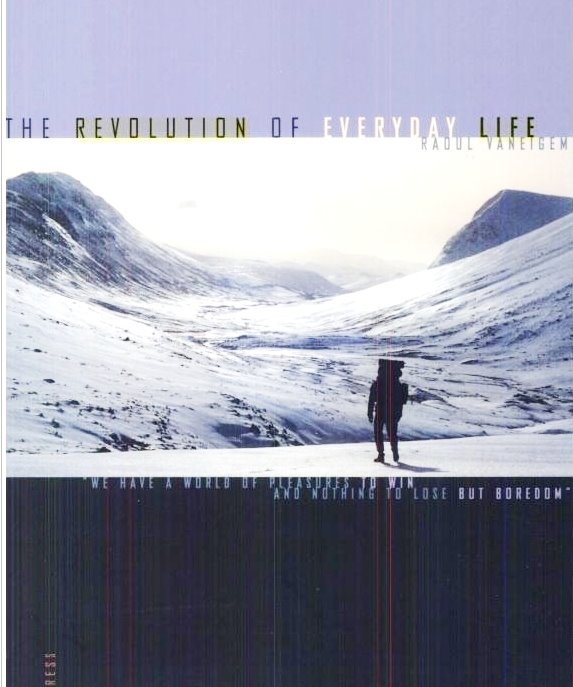
It all starts with you

So here I go from extolling the virtues of virtual consumerism on Amazon and hyping my favorite TV show to beating the drum about this radical anti-consumerist tract. How can two such divergent sentiments possibly co-exist? Perhaps I’m not just a consumer or a radical, but an armchair rad-sumer (that was supposed to be funny, in print it just looks stupid, oh well).

More relevant than ever, The Revolution of Everyday Life, written by Raoul Vaneigem in the late 60s, is a far easier read than the similair work by Debord, The Society of the Spectacle. It attempts to dissect the complex web of consumerism that we’re all caught up in and provide a few pointers to what an authentic life looks like in the face of such a sophisticated and effective onslaught—an onslaught that amounts to a commoditization of human life. Call him a leftist, pinko, or whatever, his call for a return to a more spiritual approach to life seems ironic but is not. I think it’s just an example of how we all yearn for the same things, regardless of the stories we tell ourselves.

Wednesday, September 13, 2006

Ivan Illich

You’re about 20, in school, taking philosophy courses here and there, and just not getting it. And every so often, the instructor assigns a book that, well, you still don’t get but somehow never forget. Illich’s Tools for Conviviality is one such book.

He prose can be relatively dense and difficult to decipher, but not always:

‘I believe that a desirable future depends on our deliberately choosing a life of action over a life of consumption, on our engendering a lifestyle which will enable us to be spontaneous, independent, yet related to each other, rather than maintaining a lifestyle which only allows to make and unmake, produce and consume - a style of life which is merely a way station on the road to the depletion and pollution of the environment. The future depends more upon our choice of institutions which support a life of action than on our developing new ideologies and technologies. (Illich 1973a: 57)’

Yea-he's the man-pick up a used copy at Amazon or read more about him here.

---"Man must choose whether to be rich in things or in the freedom to use them” Ivan Illich

Wednesday, August 30, 2006

ee cummings

Since he was in all the grammar school literature texts due to his way with punctuation and spelling, I always thought he was a poet for children and didn't think much about his work. Until I came across this…like all great poetry, it operates in that sublime space beyond words. How can one speak of the essence of love except in such a way?


[somewhere i have never travelled]

somewhere i have never travelled,gladly beyond
any experience,your eyes have their silence:
in your most frail gesture are things which enclose me,
or which i cannot touch because they are too near

your slightest look easily will unclose me
though i have closed myself as fingers,
you open always petal by petal myself as Spring opens
(touching skilfully,mysteriously) her first rose

or if your wish be to close me,i and
my life will shut very beautifully, suddenly,
as when the heart of this flower imagines
the snow carefully everywhere descending;

nothing which we are to perceive in this world equals
the power of your intense fragility: whose texture
compels me with the color of its countries,
rendering death and forever with each breathing

(i do not know what it is about you that closes
and opens; only something in me understands
the voice of your eyes is deeper than all roses)
nobody,not even the rain, has such small hands

Wednesday, August 16, 2006

Bukowski

Bukowski…the uninhibited bachelor: drunk, slobby, anti-social, vulgar, utterly free, and possibly the best American poet of the 20th century. I watched a movie the other day where one of the characters said the secret words of life were ‘be present’. Bukowski was the only poet I got as a young adult (yea--so I was a bit slow when it came to such things) probably because he was so present and direct, as Bono says in the documentary ‘Bukowski: Born Into This’ he went to the bone, the marrow of the bone with his direct style.

He didn’t even start writing poetry until he recovered from a life threatening illness in his 30’s, but continued to work as a postal clerk to pay the bills. It wasn’t until he was 49 that he started writing full time. As he explained in a letter at the time, "I have one of two choices -- stay in the post office and go crazy ... or stay out here and play at writer and starve. I have decided to starve.”

Be Kind

we are always asked
to understand the other person's
viewpoint
no matter how
out-dated
foolish or
obnoxious.

one is asked
to view
their total error
their life-waste
with
kindliness,
especially if they are
aged.

but age is the total of
our doing.
they have aged
badly
because they have
lived
out of focus,
they have refused to
see.

not their fault?

whose fault?
mine?

I am asked to hide
my viewpoint
from them
for fear of their
fear.

age is no crime

but the shame
of a deliberately
wasted
life

among so many
deliberately
wasted
lives

is.

Charles Bukowski

Friday, August 04, 2006

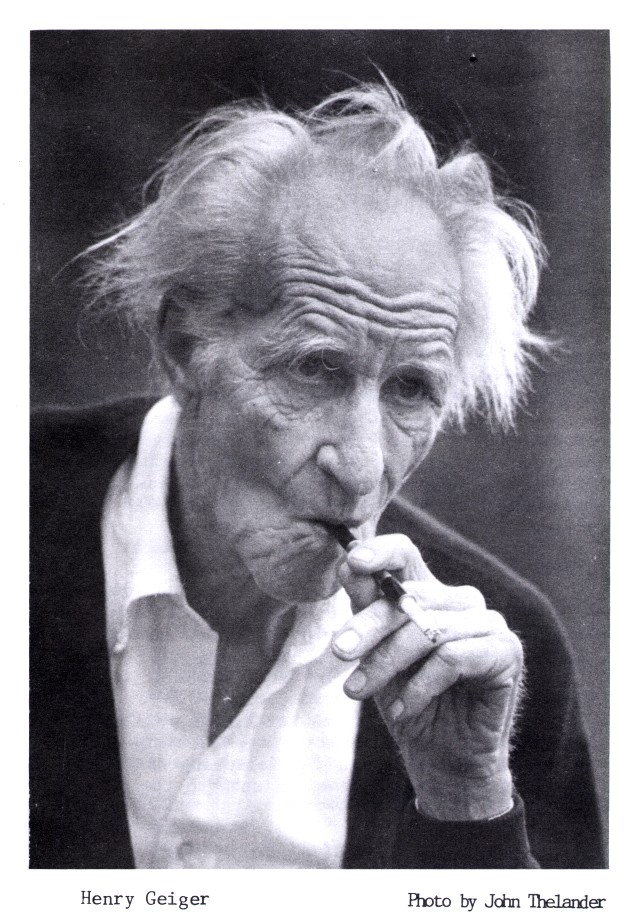
Henry Gieger & MANAS

I'd like to be like him when I grow up...hah, fat chance! MANAS, a "weekly journal of independent inquiry," ceased publication on December 28, 1988, not quite 41 years after its first issue. Henry Geiger, the man who conceived the publication and wrote almost every word of each eight-page issue, died February 15, 1989, at the age of 80.

Abraham Maslow once called him "the only small 'p' philosopher America has produced in this century"' and a Canadian journalist who read MANAS for six months but had never met Geiger wrote a feature column about him entitled "Socrates Lives Again in Los Angeles."

Go to the MANAS site and read some of his stuff-it will make you happy.

Tuesday, June 13, 2006

Stendhal


I once read part of Stendhal’s The Red and the Black and loved it. Unfortunately, I lost it before I even got a fourth of the way through. What struck me was that, even in translation, how contemporary the novel was, making it totally readable with not a hint of being dated (it was published almost 200 years ago). One of the hallmarks of a classic is that it reads like it was written yesterday-something about illuminating the universals...

As someone says to the protagonist Julien: 'Truth is austere, sir...You must take care to guard your conscience carefully from this weakness: Excess of feeling for vain exterior charm.' Quite so: dialog like that makes one realize that at least someone has really thought about this crazy life.

Since this Stendhal fellow is soooo cool, I thought I’d borrow the title of his memoir for my journal, just for awhile.

P.S. Found it, finished it, loved it-considered the first 'modern novel' in the way it deals with the complexity of the human condition given the world we now live in-read it!

Wednesday, May 17, 2006

Some greats

OK, so I'm straying from the Spokane theme. I'll get to it someday.

Try any of these gems and I guarantee an effect on your very being-no kidding!

All the King's Men, Robert Penn Warren

The great American novel (according to me). Much less about the ‘dictator of Louisiana’ than a wonderfully lyrical meditation on a man finding himself. You guys out there got that?

Portrait of a Lady, James

Where James contemplates the contrast between appearance and reality and the perils of not seeing.

The Good Soldier: A Tale of Passion, Ford Madox Ford

Ouch! Sometimes it all ends in confusion.

Women in Love, D.H. Lawrence

Wow! Don’t let your kids see this-or better yet, make them read and discuss.

Sentimental Education, Flaubert

This guy can really write.

Money and leisure can be a curse. It’s kind of a 19th century predecessor of ‘Seinfield’ without the humor. If you read this-please tell me what you think-I absolutely need to know!

A House for Mr. Biswas, V.S. Naipaul

Is it all really this futile? I mean, the poor guy just wanted a house. But really, the novel captures the fundamental nature of the human condition.

The Perennial Psychology of the Bhagavad Gita, Swami Rama

Captures the essence of this beautiful, religious, hmm…no psychological work. It won’t necessarily make you a better person, but at least you’ll know a way (hint-it’s all about the yoga).